Table of Contents
- Why Safety Matters When Choosing Baby Clothes
- Safe Fabrics for Baby Clothes: What to Look For
- How Should Baby Clothes Fit: Comfort and Safety
- Baby Clothes Safety Checklist: Design Hazards to Avoid
- How to Wash New Baby Clothes Before Use
- Age-Specific Safety and Fit Checks
- Building Your Newborn Wardrobe Safely
- Frequently Asked Questions
Last Updated: October 16, 2026
Why Safety Matters When Choosing Baby Clothes
When you're preparing for a newborn, knowing how to choose safe baby clothes isn't negotiable. Your baby's skin is delicate, and unsafe clothing can cause discomfort, allergic reactions, or serious injury.
Safety concerns fall into four categories: fabric quality, chemical exposure, choking hazards, and fit-related risks.
Safe Fabrics for Baby Clothes: What to Look For
Because babies can't regulate temperature like adults, soft, breathable fabrics are essential.
Natural Fiber Options
Natural fibers are the safest choice.
Bamboo is soft, naturally hypoallergenic, and gentle on sensitive skin.
Muslin is lightweight, breathable, and softens with each wash, perfect for layering and swaddling.
Cotton jersey knit stretches and moves with your baby without restricting movement.
Avoid synthetic blends: polyester and acrylic trap heat and moisture, increasing irritation risk.
Chemical Treatments and Textile Labels
Always check the label before buying, it tells you exactly what's touching your baby's skin.
Look for certifications like OEKO-TEX Standard 100, which means the fabric has been tested for harmful chemicals (OEKO-TEX® STANDARD 100).
Untreated fabrics are best, finishes that make clothes softer or wrinkle-resistant often irritate sensitive skin.
Avoid heavily dyed clothing for newborns, white, cream, and pastels use fewer dyes than bright colors.
Wash new clothes before wearing to remove residual dyes and chemicals, using gentle detergent and warm water.
How Should Baby Clothes Fit: Comfort and Safety
Proper fit prevents multiple safety issues: too-loose clothes become hazards, and too-tight clothes restrict movement.
Freedom of Movement and Practicality
Your baby needs room to move, restrictive clothing limits arm and leg movement and affects development.
Avoid drawstrings, which pose strangulation and choking hazards, elastic waistbands or snaps are safer. Ribbed leg openings stay snug without restricting movement, and sleeves should allow full arm movement, since babies need their hands at their mouth for soothing.
Sizing and Room to Grow
Newborns grow rapidly. Choosing the right size balances fit with room to grow, and too-small clothing becomes unsafe quickly. Newborn sizes typically fit 0-3 months; buying both newborn and 0-3 month sizes gives flexibility.
Check the weight and length ranges on the label, more reliable than age-based sizing. Allow about one finger's width of space in the shoulders, and make sure pants and sleeves reach the wrists and ankles without bunching or dragging.
Baby Clothes Safety Checklist: Design Hazards to Avoid
Most baby-clothing injuries are not caused by the fabric. They come from small parts that detach, cords that catch, and fasteners that fail.
A Repeatable Inspection Sequence
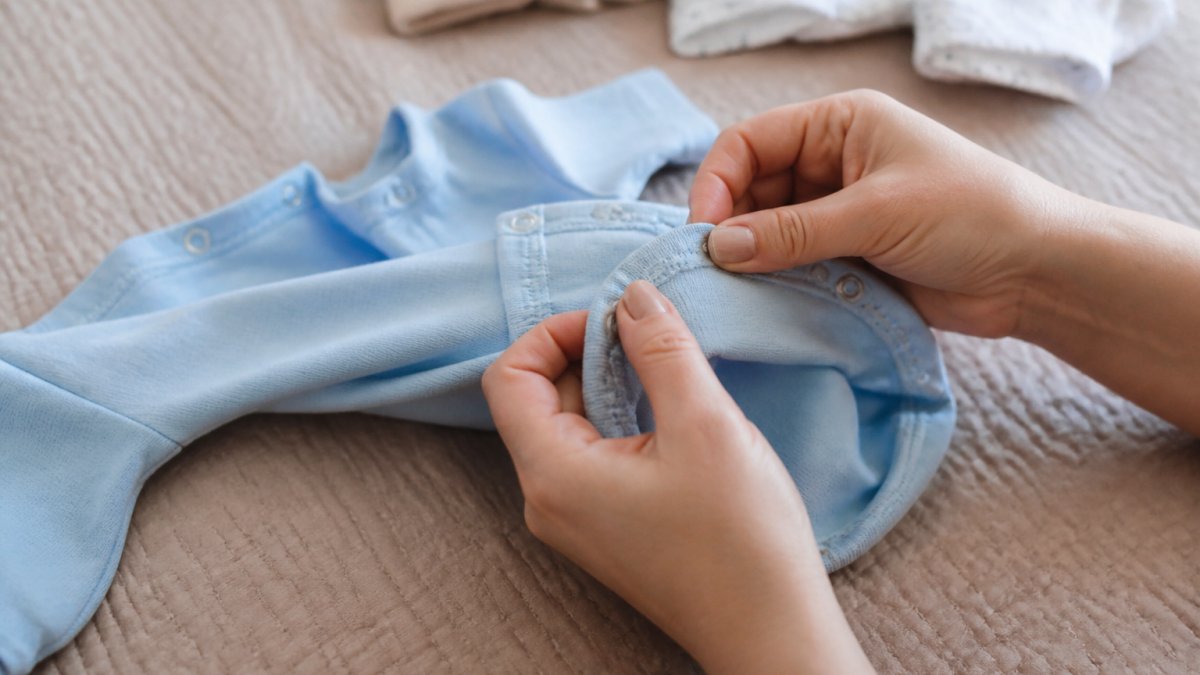
Work through the garment in the same order every time so nothing gets skipped:
- Neck and hood area. Check for drawstrings, cords, toggles, and hoods. Any cord that can be grabbed or caught is a strangulation risk.
- Fasteners. Tug each button, snap, and zipper pull. Test zipper sliders for sharp edges and make sure the pull tab cannot detach.
- Trims and decorations. Run a fingernail under every appliqué, bead, sequin, bow, and pom-pom. If it lifts, it can come off.
- Seams and hems. Pull gently along each seam. Loose stitching becomes a thread your baby can wrap around a finger or swallow.
- Interior. Turn the garment inside out. Check for loose threads, exposed elastic ends, and scratchy label edges.
- Overall fit. Confirm the neckline, armholes, and leg openings are snug enough to stay put but loose enough to slip two fingers under.
Drawstrings, Cords, and Neck Openings
Drawstrings are the single most dangerous design feature in baby clothing. Health Canada and consumer-safety guidance for children's upper outerwear advise against hood and neck drawstrings altogether for this age group (Notice of danger to human health or safety and risk mitigation for children’s upper...).
Waist drawstrings are less risky but still worth avoiding. If a garment has one, it should be stitched to the back of the casing so it cannot pull free, and the ends should be short.
Neck openings deserve their own check. A neckline that stretches wide enough to slip over the shoulders can also ride up over the face.
Snaps, Buttons, Zippers, and Hook-and-Loop
- Snaps. Metal and plastic snaps should be crimped flat with no rocking. A snap that spins in its setting is already failing. Plastic snaps can crack; metal snaps can rust after repeated washing.
- Buttons. Sewn-on buttons are a choking hazard if the thread is loose. Tug each one firmly. If it moves, re-sew it with doubled thread or replace it with a snap.
- Zippers. Look for a fabric guard behind the zipper so it never touches skin, and a zipper pull that is either covered or too large to swallow. Small metal pulls are a known detachable-part risk.
Trims, Appliqués, and Loose Threads
Decorative elements are the most common source of detachable small parts in baby clothing. Beads, sequins, rhinestones, pom-poms, and glued-on appliqués can all work loose in the wash or in a baby's mouth.
Newborn Baby Girls 14 Pc Layette Baby Shower Gift →
Loose threads are easy to overlook. A thread long enough to wrap around a finger or toe can cut off circulation.
A Quick Pre-Wear Pass
Before the first wear and again after every few washes: shake the garment, listen for rattling small parts, tug every fastener, run a finger along every seam, and turn it inside out. If anything moves, cracks, or lifts, repair it or retire the garment. This habit prevents most design-related clothing injuries.
Health Canada consumer product safety and recall database
How to Wash New Baby Clothes Before Use
New clothes contain manufacturing residue; washing removes chemicals, dyes, and dust before wear.
Wash in warm water on a gentle cycle; hot water can damage delicate fabrics, while gentle cycles protect elastic and seams.
Wash separately from adult clothes the first time to prevent color bleeding and chemical transfer; after that, combine loads.
Age-Specific Safety and Fit Checks
Safety needs change with every motor milestone. A garment that is safe for a newborn can become a hazard the moment that baby starts rolling, crawling, or pulling at their own clothes. The fit checks below are organized by what your baby can actually do, not just by age.
Newborn to About 3 Months: Stationary but Sensitive
At this stage, the priorities are skin comfort and nothing that can cover the face.
- Fit check: Slip two fingers under the neckline, armholes, and leg openings. If you cannot, the garment is too tight. If the whole hand fits easily, it is too loose and can ride up.
- Hazards: Loose fabric near the face, rough interior seams, scratchy labels, and any detachable decoration.
- Sleepwear: A fitted sleeper or a correctly sized sleep sack. No loose blankets, pillows, or bumper pads in the sleep space.
Rolling and Reaching (Around 4-6 Months)
Once a baby can roll, loose fabric becomes a movement and breathing hazard during sleep.
- Fit check: Lay the baby on their back and roll them gently side to side. The garment should move with them, not bunch around the neck or face.
- Hazards: Wide necklines that ride up, long sleeves that cover the hands and get pulled into the mouth, and any cord or ribbon within reach.
- Sleepwear: Fitted sleepwear only. Check that the fabric does not gather over the face when the baby rolls.
Crawling and Sitting (Around 7-10 Months)
Crawling changes the risk profile. Knees drag, fabric catches, and babies start pulling at their own clothing.
- Fit check: Have the baby crawl a few steps. Pants should not slide down or twist, and knees should not be restricted. Cuffs should not drag on the floor where they can be stepped on or caught.
- Hazards: Snaps and buttons on the front of the garment that a baby can reach and pull, long ties, and loose hems that catch on furniture edges.
- Practical note: Footed sleepers without grippy soles can be slippery on smooth floors once a baby is pulling to stand. Look for slip-resistant soles on walker-age garments.
Pulling to Stand and Cruising (Around 10-18 Months)
This is when clothing gets grabbed, stretched, and pulled, by the baby and by the environment.
- Fit check: Watch the baby pull to stand at a couch or crib rail. Nothing should catch, and the neckline should not stretch enough to slip over a shoulder.
- Hazards: Drawstrings and cords that can catch on crib rails or furniture, loose hoods, and any fastener a baby can work free and put in their mouth.
- Sleepwear: Continue with fitted sleepwear. Once a baby can climb or unzip, consider a sleep sack with a zipper that closes at the top or a back-zip design.
A Weekly Fit Routine
Growth is not linear, so a garment that fit last week may not fit this week. Once a week, do a quick pass:
- Check shoulders, you should be able to fit about one finger's width of space, no more.
- Check sleeves and pant legs, they should reach the wrist and ankle without bunching at the joints.
- Check the neckline, it should not stretch over the shoulders.
Seasonal Adjustments by Stage
A newborn who cannot regulate temperature needs one more layer than an adult in the same room. A crawling baby generates more heat and needs less. In summer, choose lighter fabrics and shorter sleeves; in winter, layer thin, breathable pieces rather than one thick garment, so you can remove a layer indoors without undressing the baby completely.
Building Your Newborn Wardrobe Safely
Start with essentials, babies wear clothes briefly before outgrowing them.
Lewlin & Company offers carefully selected layette sets that check all safety boxes. The Newborn Baby Boys 18 Pc Layette Baby Shower Gift includes 100% cotton onesies with expandable necklines and front snap closures.

For girls, the Newborn Baby Girls 14 Pc Layette Baby Shower Gift offers similar quality at $36.83.

The Pastel Girls Short Sleeve 6 Pack at $15.67 provides versatile basics in 100% cotton rib knit.

Invest in quality over quantity, well-made clothes last through multiple washes and are safer and more comfortable.
Buy seasonal items as needed, your baby will outgrow stockpiled clothes before you use them.
Frequently Asked Questions
What fabrics are best for a baby's sensitive skin?
Natural fibers like organic cotton, bamboo, and muslin are gentlest on sensitive skin. Look for untreated fabrics without chemical dyes or finishes. Jersey knit and soft cotton blends offer breathability and comfort. Check care labels for certifications indicating minimal processing. Avoid synthetic materials and heavy polyester blends that trap moisture and heat.
How can you tell if baby clothes are safe?
Inspect for loose threads, missing or loose buttons, and sharp fasteners. Check that drawstrings are short or non-existent, and Velcro closures are secure. Read the care label for chemical treatments or dyes. Look for expandable shoulder necklines and front snap closures for easy diaper changes. Verify the garment fits snugly without excess fabric that could cause overheating, especially for sleepwear.
How do you wash new baby clothes before use?
Wash new baby clothes separately in warm water with a gentle, fragrance-free detergent before the baby wears them. This removes dyes, chemical residues, and finishes applied during manufacturing. Machine wash on a gentle cycle and tumble dry on low heat or air dry. Avoid fabric softeners and bleach. Wash in small batches to ensure thorough rinsing and prevent color bleeding.
Are baby clothes with snaps or zippers safer?
Front snap closures are safer and more convenient for diaper changes, reducing the time your baby is exposed to cold air. Snaps are easier for parents to manage quickly. Zippers can pinch skin or get stuck, and drawstrings pose strangulation hazards. Choose garments with secure snaps positioned at the front, and avoid clothing with loose drawstrings or decorative cords around the neck or waist.
Choosing safe baby clothes protects your newborn while keeping them comfortable. Focus on soft, natural fabrics, proper fit, and secure construction. Lewlin & Company makes this easier by curating layette sets and clothing essentials that meet safety standards. Start with trusted basics, wash everything before use, and inspect garments regularly. Your baby deserves clothing that's as safe as it is comfortable.